Publications
Lead Projects
- [2023] Quantifying Molecular Deformation in Polymer Melts by a Generalized Zimm Plot Approach
More InfoJournal of Applied Crystallography. 2023. 56, 1168-1179.
Christopher N. Lam, Lilin He, Changwoo Do, Wei-Ren Chen, Weiyu Wang, Kunlun Hong, and Yangyang Wang.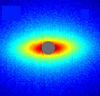
The Zimm plot has been widely used to characterize the molecular dimensions of polymers from small-angle scattering experiments, where the reciprocal intensity is analyzed as a function of the square of the magnitude of the scattering wavevector Q. This work explores the benefits of analyzing the reciprocal scattering intensity from deformed polymers, extending the original Zimm plot to anisotropic materials. In the small-angle limit, a tensorial extension of the Guinier law is found for the gyration tensor and the reciprocal single-chain structure factor. In the high-Q limit, application of the spherical harmonic expansion technique to the reciprocal structure factor permits direct model-independent analysis of spatially dependent molecular deformation of polymers. Additionally, the contributions from high-order spherical harmonics become insignificant in the reciprocal-intensity representation. The proposed generalized Zimm plot approach is demonstrated computationally with the affine deformation model and the Rouse model, and experimentally with small-angle neutron scattering measurements of deformed polystyrene melts.
- [2019] Structural Properties of the Evolution of CTAB/NaSal Micelles Investigated by SANS and Rheometry
More InfoPhysical Chemistry Chemical Physics. 2019. 21, 18346-18351.
Christopher N. Lam, Changwoo Do, Yangyang Wang, Guan-Rong Huang, and Wei-Ren Chen.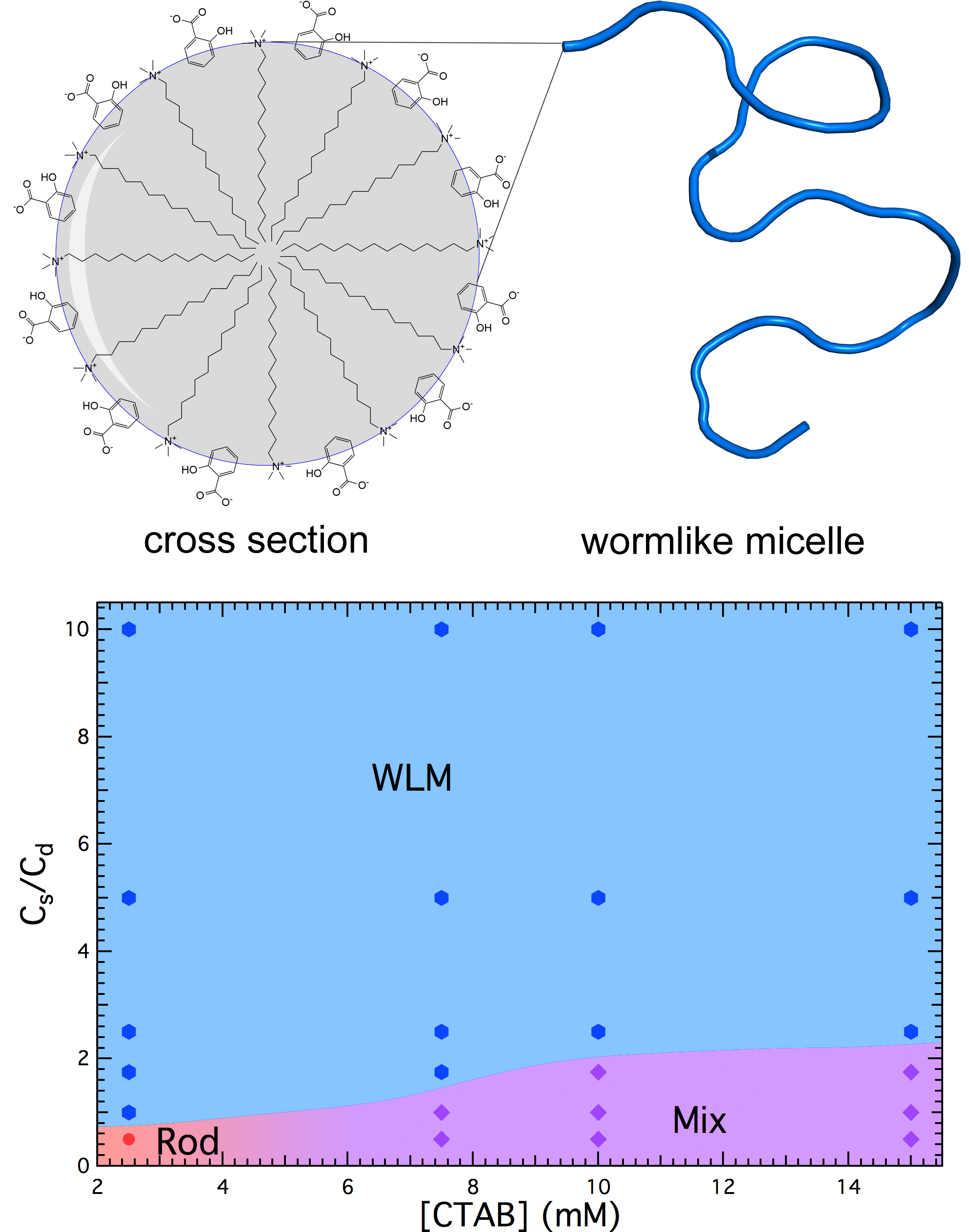
Surfactants are amphiphilic molecules that spontaneously self-assemble in aqueous solution into various ordered and disordered phases. Under certain conditions, one-dimensional structures in the form of long, flexible wormlike micelles can develop. Cetyltrimethylammonium bromide (CTAB) is one of the most widely studied surfactants, and in the presence of sodium salicylate (NaSal), wormlike micelles can form at very dilute concentrations of surfactant. We carry out a systematic study of the structures of CTAB/NaSal over a surfactant concentration range of 2.5–15 mM and at salt-to-surfactant molar ratios of 0.5–10. Using small-angle neutron scattering (SANS), we qualitatively and quantitatively characterize the equilibrium structures of CTAB/NaSal, mapping the phase behavior of CTAB/NaSal at low concentrations within the region of phase space where nascent wormlike micelles transition into long and entangled structures. Complementary rheological assessments not only demonstrate the significant influence of the inter-micellar Coulombic interaction on the micellar structure but also suggest the potential existence of a hierarchical structure which is beyond the accessibility of the SANS technique.
- [2018] Scaling Behavior of Anisotropy Relaxation in Deformed Polymers
More InfoPhysical Review Letters. 2018. 121, 117801.
Christopher N. Lam, Wen-Sheng Xu, Wei-Ren Chen, Zhe Wang, Christopher B. Stanley, Jan-Michael Y. Carrillo, David Uhrig, Weiyu Wang, Kunlun Hong, Yun Liu, Lionel Porcar, Changwoo Do, Gregory S. Smith, Bobby G. Sumpter, and Yangyang Wang.Drawing an analogy to the paradigm of quasielastic neutron scattering, we present a general approach for quantitatively investigating the spatiotemporal dependence of structural anisotropy relaxation in deformed polymers by using small-angle neutron scattering. Experiments and nonequilibrium molecular dynamics simulations on polymer melts over a wide range of molecular weights reveal that their conformational relaxation at relatively high momentum transfer Q and short time can be described by a simple scaling law, with the relaxation rate proportional to Q. This peculiar scaling behavior, which cannot be derived from the classical Rouse and tube models, is indicative of a surprisingly weak direct influence of entanglement on the microscopic mechanism of single-chain anisotropy relaxation.
- [2016] The Effect of Protein Electrostatic Interactions on Globular Protein-Polymer Block Copolymer Self-Assembly
More InfoBiomacromolecules. 2016. 17 (9), 2820-2829.
Christopher N. Lam, Helen Yao, and Bradley D. Olsen.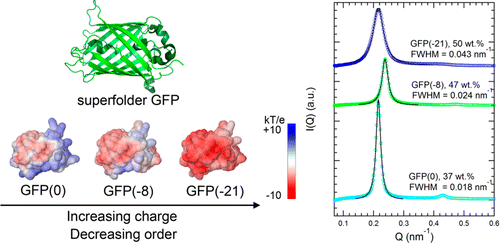
Protein-polymer conjugation can significantly affect many different aspects of protein behavior, ranging from their solution properties to their ability to form solution and bulk nanostructured materials. An underlying fundamental question is how the molecular design affects the shape of the conjugate and, consequently, its properties. This work measures the molecular configuration of model protein-polymer conjugates in dilute solution using small-angle neutron scattering (SANS) and uses quantitative model fitting to understand the shape of the molecules. Form factor measurements of four model bioconjugates of the red fluorescent protein mCherry and the polymers poly(N-isopropylacrylamide), poly(hydroxypropyl acrylate), poly(oligoethylene glycol acrylate), and poly(ethylene glycol) show that these protein-polymer conjugates are well described by a recently developed scattering function for colloid-polymer conjugates that explicitly incorporates excluded volume interactions in the polymer configuration. In the regime where the protein does not exhibit strong interactions with the polymer, modeling the protein-polymer interactions using a purely repulsive Weeks-Chandler-Andersen potential also leads to a coarse-grained depiction of the conjugate that agrees well with its scattering behavior. The coarse-grained model can additionally be used for systems with varying protein-polymer interactions, ranging from purely repulsive to strongly attractive, which may be useful for conjugates with strong electrostatic or hydrophobic attractive interactions.
- [2016] The Shape of Protein-Polymer Conjugates in Dilute Solution
More InfoJournal of Polymer Science, Part A: Polymer Chemistry. 2016. 54 (2), 292-302.
Christopher N. Lam, Dongsook Chang, Muzhou Wang, Wei-Ren Chen, and Bradley D. Olsen.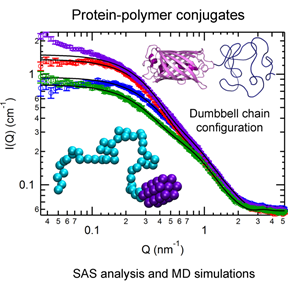
Protein–polymer conjugation can significantly affect many different aspects of protein behavior, ranging from their solution properties to their ability to form solution and bulk nanostructured materials. An underlying fundamental question is how the molecular design affects the shape of the conjugate and, consequently, its properties. This work measures the molecular configuration of model protein–polymer conjugates in dilute solution using small-angle neutron scattering (SANS) and uses quantitative model fitting to understand the shape of the molecules. Form factor measurements of four model bioconjugates of the red fluorescent protein mCherry and the polymers poly(N-isopropylacrylamide), poly(hydroxypropyl acrylate), poly(oligoethylene glycol acrylate), and poly(ethylene glycol) show that these protein–polymer conjugates are well described by a recently developed scattering function for colloid–polymer conjugates that explicitly incorporates excluded volume interactions in the polymer configuration. In the regime where the protein does not exhibit strong interactions with the polymer, modeling the protein–polymer interactions using a purely repulsive Weeks–Chandler–Andersen potential also leads to a coarse-grained depiction of the conjugate that agrees well with its scattering behavior. The coarse-grained model can additionally be used for systems with varying protein–polymer interactions, ranging from purely repulsive to strongly attractive, which may be useful for conjugates with strong electrostatic or hydrophobic attractive interactions.
- [2014] The Nature of Protein Interactions Governing Globular Protein-Polymer Block Copolymer Self-Assembly
More InfoBiomacromolecules. 2014. 15 (4), 1248-1258.
Christopher N. Lam, Minkyu Kim, Carla S. Thomas, Dongsook Chang, Gabriel E. Sanoja, Chimdimma U. Okwara, and Bradley D. Olsen.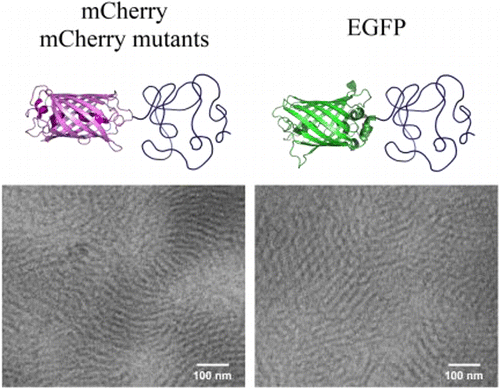
The effects of protein surface potential on the self-assembly of protein-polymer block copolymers are investigated in globular proteins with controlled shape through two approaches: comparison of self-assembly of mCherry-poly(N-isopropylacrylamide) (PNIPAM) bioconjugates with structurally homologous enhanced green fluorescent protein (EGFP)-PNIPAM bioconjugates, and mutants of mCherry with altered electrostatic patchiness. Despite large changes in amino acid sequence, the temperature-concentration phase diagrams of EGFP-PNIPAM and mCherry-PNIPAM conjugates have similar phase transition concentrations. Both materials form identical phases at two different coil fractions below the PNIPAM thermal transition temperature and in the bulk. However, at temperatures above the thermoresponsive transition, mCherry conjugates form hexagonal phases at high concentrations while EGFP conjugates form a disordered micellar phase. At lower concentration, mCherry shows a two-phase region while EGFP forms homogeneous disordered micellar structures, reflecting the effect of changes in micellar stability. Conjugates of four mCherry variants with changes to their electrostatic surface patchiness also showed minimal change in phase behavior, suggesting that surface patchiness has only a small effect on the self-assembly process. Measurements of protein/polymer miscibility, second virial coefficients, and zeta potential show that these coarse-grained interactions are similar between mCherry and EGFP, indicating that coarse-grained interactions largely capture the relevant physics for soluble, monomeric globular protein-polymer conjugate self-assembly.
- [2013] Phase Transitions in Concentrated Solution Self-Assembly of Globular Protein-Polymer Block Copolymers
More InfoSoft Matter (front cover). 2013. 9, 2393-2402.
Christopher N. Lam and Bradley D. Olsen.
February 2013 Science Highlight by U.S. Department of Energy (DOE) Basic Energy Sciences (BES).
The phase behaviour of mCherry-b-PNIPAM (mChP) block copolymers with four different PNIPAM coil fractions is investigated in concentrated aqueous solution as a function of both concentration and temperature, demonstrating both order-order transitions (OOTs) and order-disorder transitions (ODTs) in globular protein-polymer block copolymers. Independent of coil volume fraction from 0.25 to 0.70, the temperature-concentration phase diagrams share several common features. At low concentrations, mCherry-b-PNIPAM forms a homogeneous disordered phase, and macrophase separation into an ordered conjugate-rich phase and a solvent-rich phase is observed at temperatures above the PNIPAM thermoresponsive transition temperature. mChP solutions are also observed to undergo a low-temperature ODT driven by increasing concentration. The order-disorder transition concentration (ODTC) behaviour of mChP is minimized for symmetric conjugates, suggesting that repulsive solvent-mediated protein-polymer interactions provide a driving force for self-assembly. Both coil fraction and solvent selectivity have large effects on the morphologies formed-disordered micelles, hexagonally packed cylinders, lamellae, and perforated lamellae are identified with the combination of small-angle X-ray scattering (SAXS), depolarized light scattering (DPLS), turbidimetry, and differential scanning calorimetry (DSC). An OOT is observed upon increasing temperature for three of the studied coil fractions at concentrations of 40-50 wt% due to changing solvent selectivity. SANS contrast-matching experiments show that water is weakly selective for PNIPAM at low temperatures and strongly selective for mCherry at high temperatures.
Collaborations
- [2022] Influence of Pyrolytic Decomposition on the Microstructure Evolution of Benzoxazine-Derived Carbon-Carbon Composites
More InfoComposites & Nanocomposites. 2022. 57, 21915-21934.
Faheem Muhammed, Laure Moretti, Tania Lavaggi, Christopher Lam, Tao Tao, Suresh Advani, and John W. Gillespie Jr.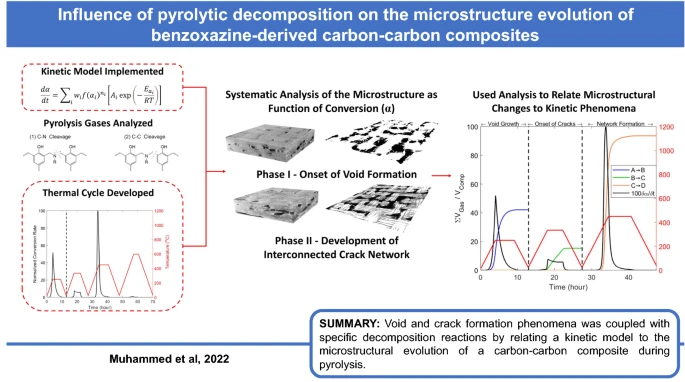
The microstructural evolution of a T800 2 x 2 twill weave carbon fiber/benzoxazine resin composite was quantified through the pyrolytic decomposition region of 250-800 °C. In performing kinetic analysis, three stages of mass loss were identified and quantified through a non-isothermal kinetics model. The kinetics model parameters were determined at each state of the reaction, and the corresponding decomposition gases were analyzed to gain insight into pyrolytic reactions. The kinetics model was then used to design a heat treatment cycle that isolated each stage of the reaction so that the effects on the progression of the porous microstructure could be characterized. In the first stage of the reaction, the nucleation and growth of voids were dominant. In the second stage, the initiation of microcracks within the matrix was observed. The third stage saw the formation of an interconnected porous network in which cracks propagated throughout the composite and formed a continuous pathway from the surface to the centermost voids. To evaluate these microstructural features, X-ray computed tomography was utilized. In doing so, the various damage phenomena including void size, the degree of open and closed porosity, and the crack density were quantified.
- [2021] Ion Atmosphere of Wormlike Micelles Profiled by Contrast Variation Small-Angle Neutron Scattering
More InfoACS Macro Letters. 2021. 11, 1, 66-71.
Guan-Rong Huang, Christopher N. Lam, Kunlun Hong, Yangyang Wang, Yuya Shinohara, Changwoo Do, and Wei-Ren Chen.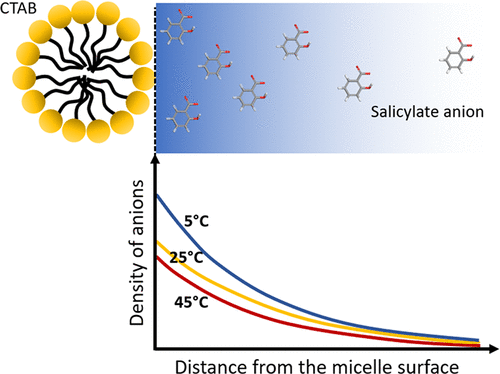
Structural studies of wormlike micelles have so far mostly focused on the conformational properties of surfactant aggregates. The diffuse ionic atmosphere, which has a profound influence on various micellization phenomena such as thermodynamic stability and structural polymorphism, remains largely unexplored experimentally. In this report a strategy of contrast variation small-angle neutron scattering for this crucial structural study is outlined. Underlined by a general criterion established for unbiasedly identifying the length scale relevant to charge association from the spectral evolution, our analytical framework can provide a quantitative description of counterion distribution in a mathematically tractable manner. Our method can be conveniently extended to facilitate structural studies of complex multicomponent systems using contrast variation neutron scattering.
- [2020] Determining Population Densities in Bimodal Micellar Solutions Using Contrast-Variation Small Angle Neutron Scattering
More InfoThe Journal of Chemical Physics. 2020. 153, 184902.
Guan-Rong Huang, Chi-Huan Tung, Dongsook Chang, Christopher N. Lam, Changwoo Do, Yuya Shinohara, Shou-Yi Chang, Yangyang Wang, Kunlun Hong, and Wei-Ren Chen.Self-assembly of amphiphilic polymers in water is of fundamental and practical importance. Significant amounts of free unimers and associated micellar aggregates often coexist over a wide range of phase regions. The thermodynamic and kinetic properties of the microphase separation are closely related to the relative population density of unimers and micelles. Although the scattering technique has been employed to identify the structure of micellar aggregates as well as their time-evolution, the determination of the population ratio of micelles to unimers remains a challenging problem due to their difference in scattering power. Here, using small-angle neutron scattering (SANS), we present a comprehensive structural study of amphiphilic n-dodecyl-PNIPAm polymers, which shows a bimodal size distribution in water. By adjusting the deuterium/hydrogen ratio of water, the intra-micellar polymer and water distributions are obtained from the SANS spectra. The micellar size and number density are further determined, and the population densities of micelles and unimers are calculated to quantitatively address the degree of micellization at different temperatures. Our method can be used to provide an in-depth insight into the solution properties of microphase separation, which are present in many amphiphilic systems.
- [2019] Influence of Side Chain Isomerism on the Rigidity of Poly(3-alkylthiophenes) in Solutions Revealed by Neutron Scattering
More InfoPhysical Chemistry Chemical Physics. 2019. 21, 7745-7749.
William D. Hong, Christopher N. Lam, Yangyang Wang, Youjun He, Luis E. Sanchez-Diaz, Changwoo Do, and Wei-Ren Chen.Using small-angle neutron scattering, we conducted a detailed conformational study of poly(3-alkylthiophene) solutions in deuterated dichlorobenzene. The focus was placed on addressing the influence of the spatial arrangement of side chain constituents on backbone conformation. We demonstrate that by introducing a branch point in the side chain, side chain steric interactions may promote torsional motion between backbone units, resulting in greater chain flexibility. Our findings highlight the key role of topological isomerism in determining the chain rigidity and throw new light on the debate about the effective approaches for optimizing the electronic properties of conducting polymers via side chain engineering.
- [2018] Molecular Dynamics Investigation of the Relaxation Mechanism of Entangled Polymers after a Large Step Deformation
More InfoACS Macro Letters. 2018. 7, 2, 190-195.
Wen-Sheng Xu, Jan-Michael Y. Carrillo, Christopher N. Lam, Bobby G. Sumpter, and Yangyang Wang.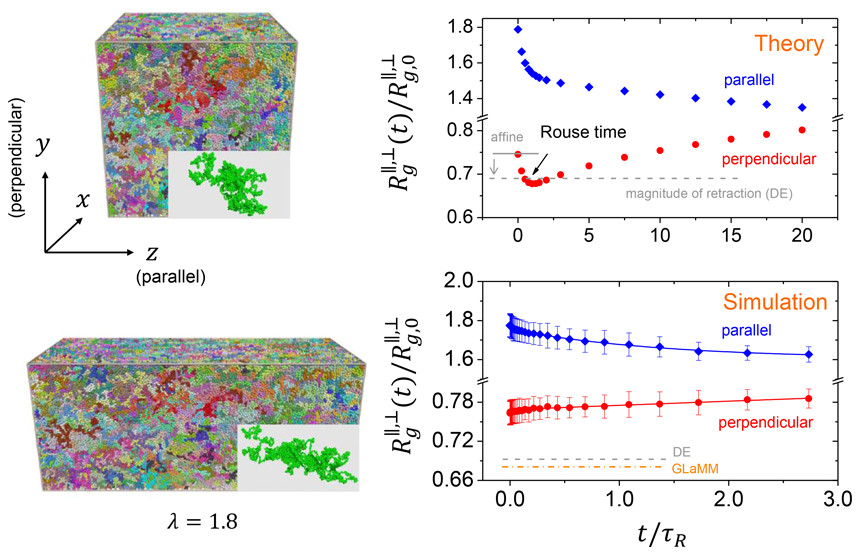
The chain retraction hypothesis of the tube model for nonlinear polymer rheology has been challenged by the recent small-angle neutron scattering (SANS) experiment (Wang, Z.; Lam, C. N.; Chen, W.-R.; Wang, W.; Liu, J.; Liu, Y.; Porcar, L.; Stanley, C. B.; Zhao, Z.; Hong, K.; Wang, Y., Fingerprinting Molecular Relaxation in Deformed Polymers. Phys. Rev. X2017, 7, 031003). In this work, we further examine the microscopic relaxation mechanism of entangled polymer melts after a large step uniaxial extension by using large-scale molecular dynamics simulation. We show that the unique structural features associated with the chain retraction mechanism of the tube model are absent in our simulations, in agreement with the previous experimental results. In contrast to SANS experiments, molecular dynamics simulations allow us to accurately and unambiguously determine the evolution of the radius of gyration tensor of a long polymer chain after a large step deformation. Contrary to the prediction of the tube model, our simulations reveal that the radius of gyration in the perpendicular direction to stretching increases monotonically toward its equilibrium value throughout the stress relaxation. These results provide a critical step in improving our understanding of nonlinear rheology of entangled polymers.
- [2017] Fingerprinting Molecular Relaxation in Deformed Polymers
More InfoPhysical Review X. 2017. 7, 031003.
Zhe Wang, Christopher N. Lam, Wei-Ren Chen, Weiyu Wang, Jianning Liu, Yun Liu, Lionel Porcar, Christopher B. Stanley, Zhichen Zhao, Kunlun Hong, and Yangyang Wang.
Viewpoint in Physics.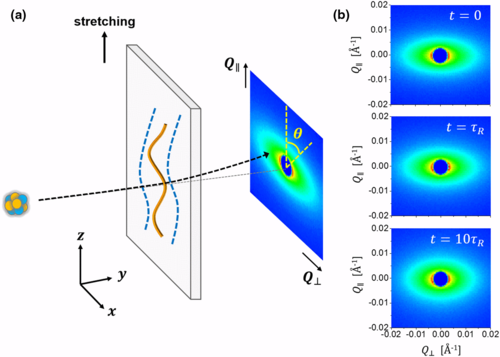
This work presents scattering functions of conjugates consisting of a colloid particle and a self-avoiding polymer chain as a model for protein-polymer conjugates and nanoparticle-polymer conjugates in solution. The model is directly derived from the two-point correlation function with the inclusion of excluded volume effects. The dependence of the calculated scattering function on the geometric shape of the colloid and polymer stiffness is investigated. The model is able to describe the experimental scattering signature of the solutions of suspending hard particle-polymer conjugates and provide additional conformational information. This model explicitly elucidates the link between the global conformation of a conjugate and the microstructure of its constituent components.
- [2015] Scattering from Colloid-Polymer Conjugates with Excluded Volume Effect
More InfoACS Macro Letters. 2015. 4, 165-170.
Xin Li, Christopher N. Lam, Luis Sanchez-Diaz, Gregory Smith, Bradley D. Olsen, and Wei-Ren Chen.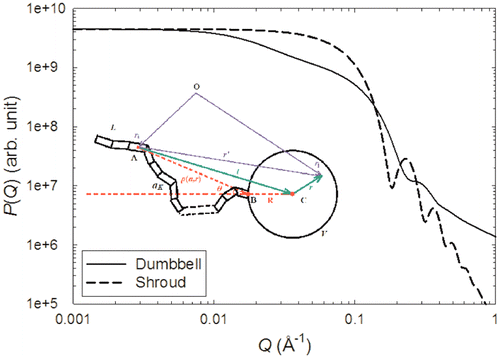
This work presents scattering functions of conjugates consisting of a colloid particle and a self-avoiding polymer chain as a model for protein-polymer conjugates and nanoparticle-polymer conjugates in solution. The model is directly derived from the two-point correlation function with the inclusion of excluded volume effects. The dependence of the calculated scattering function on the geometric shape of the colloid and polymer stiffness is investigated. The model is able to describe the experimental scattering signature of the solutions of suspending hard particle-polymer conjugates and provide additional conformational information. This model explicitly elucidates the link between the global conformation of a conjugate and the microstructure of its constituent components.
- [2014] Topological Effects on Globular Protein-ELP Fusion Block Copolymer Self-Assembly
More InfoAdvanced Functional Materials. 2014. 25 (5), 729-738.
Guokui Qin, Matthew J. Glassman, Christopher N. Lam, Dongsook Chang, Eric Schaible, Alex Hexemer, and Bradley D. Olsen.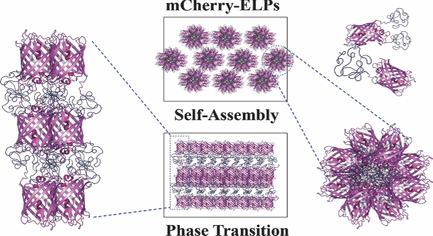
Perfectly defined, monodisperse fusion protein block copolymers of a thermoresponsive coil-like protein, ELP, and a globular protein, mCherry, are demonstrated to act as fully biosynthetic analogues to protein-polymer conjugates that can self-assemble into biofunctional nanostructures such as hexagonal and lamellar phases in concentrated solutions. The phase behavior of two mCherry-ELP fusions, E10-mCherry-E10 and E20-mCherry, is investigated to compare linear and bola fusion self-assembly both in diluted and concentrated aqueous solution. In dilute solution, the molecular topology impacts the stability of micelles formed above the thermal transition temperature of the ELP block, with the diblock forming micelles and the bola forming unstable aggregates. Despite the chemical similarity of the two protein blocks, the materials order into block copolymer-like nanostructures across a wide range of concentrations at 30 wt% and above, with the bola fusion having a lower order-disorder transition concentration than the diblock fusion. The topology of the molecule has a large impact on the type of nanostructure formed, with the two fusions forming phases in the opposite order as a function of temperature and concentration. This new system provides a rich landscape to explore the capabilities of fusion architecture to control supramolecular assemblies for bioactive materials.
- [2014] Effect of Polymer Chemistry on Globular Protein-Polymer Block Copolymer Self-Assembly
More InfoPolymer Chemistry (front cover). 2014. 5, 4884-4895.
Dongsook Chang, Christopher N. Lam, Shengchang Tang, and Bradley D. Olsen.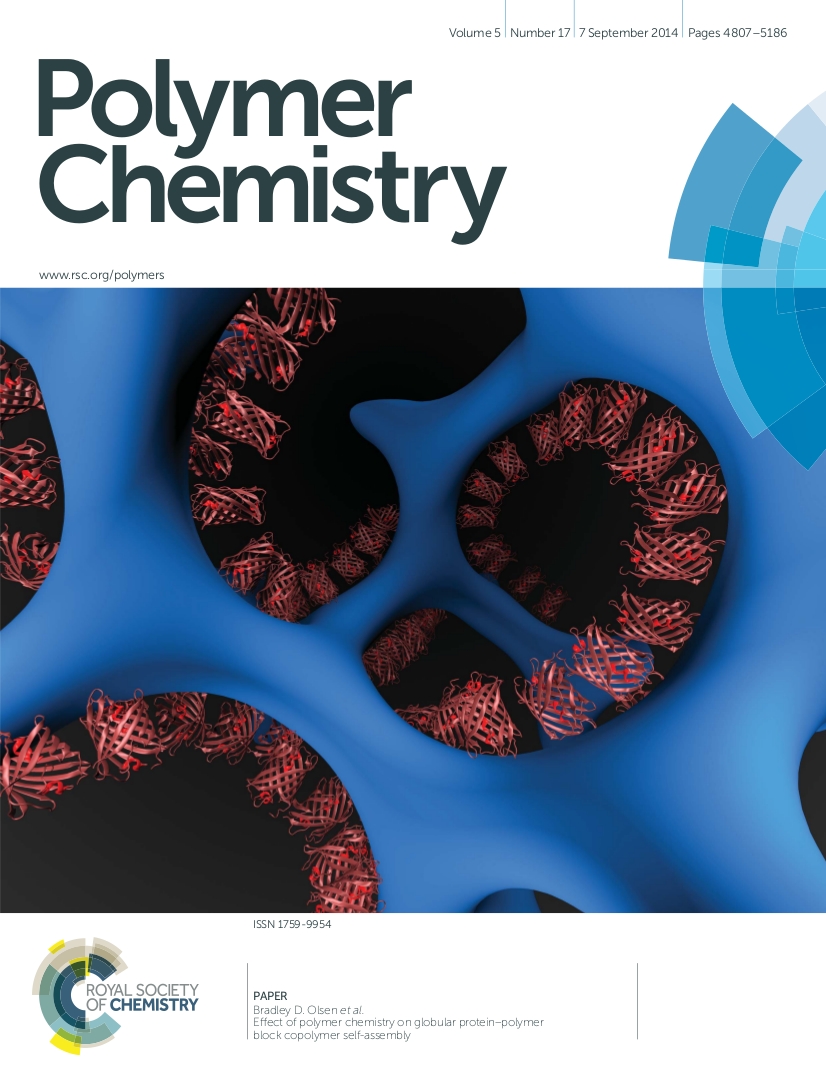
Bioconjugates of the model red fluorescent protein mCherry and synthetic polymer blocks with different hydrogen bonding functionalities show that the chemistry of the polymer block has a large effect on both ordering transitions and the type of nanostructures formed during bioconjugate self-assembly. The phase behaviours of mCherry-b-poly(hydroxypropyl acrylate) (PHPA) and mCherry-b-poly(oligoethylene glycol acrylate) (POEGA) in concentrated aqueous solution show that changes in polymer chemistry result in increase in the order-disorder transition concentrations (CODTs) by approximately 10-15 wt% compared to a previously studied globular protein-polymer block copolymer, mCherry-b-poly(N-isopropylacrylamide) (PNIPAM). The CODTs are always minimized for symmetric bioconjugates, consistent with the importance of protein-polymer interactions in self-assembly. Both mCherry-b-PHPA and mCherry-b-POEGA also form phases that have not previously been observed in other globular protein-polymer conjugates: mCherry-b-PHPA forms a cubic phase that can be indexed to Ia3d and mCherry-b-POEGA displays coexistence of lamellae and a cubic Ia3d structure over a narrow range of concentration and temperature. Several common behaviours are also revealed by comparison of different polymer blocks. With increasing concentration and temperature, ordered phases always appear in the order lamellar, cubic/PL, and hexagonal, although not all phases are observed in all materials. High concentration solutions (near 80 wt%) also undergo a re-entrant order-disorder transition to form nematic liquid crystalline phases, regardless of the polymer block chemistry.
- [2012] Nanopatterned Protein Films Directed by Ionic Complexation with Water-Soluble Diblock Copolymers
More InfoMacromolecules. 2012. 45, 4572-4580.
Bokyung Kim, Christopher N. Lam, and Bradley D. Olsen.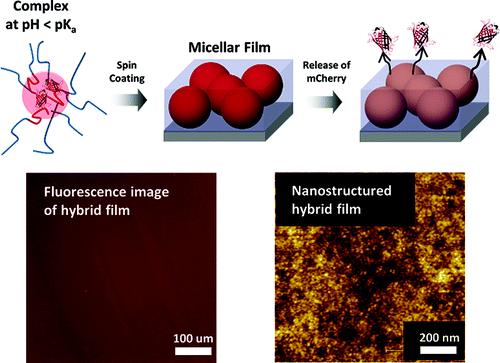
The use of ionic interactions to direct both protein templating and block copolymer self-assembly into nanopatterned films with only aqueous processing conditions is demonstrated using block copolymers containing both thermally responsive and pH responsive blocks. Controlled reversible addition-fragmentation chain-transfer (RAFT) polymerization is employed to synthesize poly(N-isopropylacrylamide-b-2-(dimethylamino)ethyl acrylate) (PNIPAM-b-PDMAEA) diblock copolymers. The pH-dependent ionic complexation between the fluorescent protein, mCherry, and the ionic PDMAEA block is established using dynamic light scattering (DLS) and UV-vis spectroscopy. DLS shows that the size of the resulting coacervate micelles depends strongly on pH, while UV-vis spectroscopy shows a correlation between the protein's absorption maximum and the ionic microenvironment. Zeta potential measurements clearly indicate the ionic nature of the complex-forming interactions. Spin-casting was used to prepare nanostructured films from the protein–block copolymer coacervates. After film formation, the lower critical solution temperature (LCST) of the PNIPAM blocks allows the nanomaterial to be effectively immobilized in aqueous environments at physiological temperatures, enabling potential use as a controlled protein release material or polymer matrix for protein immobilization. At pH 9.2 and 7.8, the release rates are at least 10 times faster than that at pH 6.4 due to weaker interaction between protein and PNIPAM-b-PDMAEA (PND) diblock copolymer. Because of the ionic environment in which protein is confined, the majority of the protein (80%) remains active, independent of pH, even after having been dehydrated in vacuum and confined in the films.
- [2010] Measuring Short-Range Repulsive Forces by Imaging Directed Magnetic-Particle Assembly
More InfoSoft Matter. 2010. 6, 239-242.
Dichuan Li, Christopher Lam, and Sibani L. Biswal.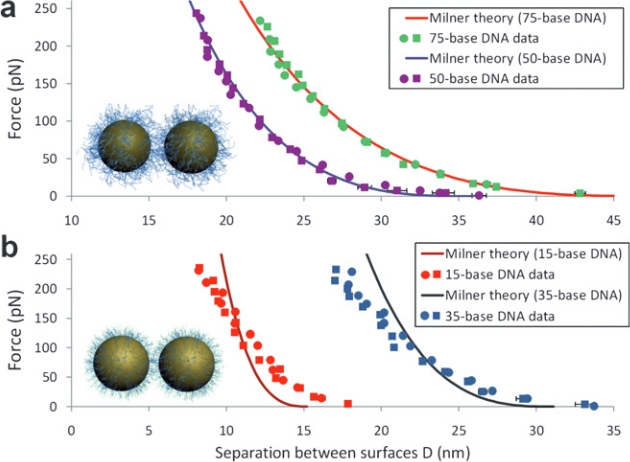
We present the use of video microscopy of magnetic colloidal particles to measure short range repulsive forces between surfaces. The forces between the particles can be directly measured by monitoring the inter-centroid distances between the particles at various magnetic field strengths. Using a chain consisting of a minimum of 35 micron-sized particles, a distance resolution of ~0.21 nm is achieved. Measurements of the interactions between charged colloids agree well with predicted force interactions calculated using DLVO theory. We also report the first measurements of the force versus distance relationship between very short (<75 bases) oligonucleotide-coated surfaces. The interactions between oligonucleotide-coated surfaces agree well with Milner's polymer brush theory for strands greater than 50 bases but deviate for strands less than 35 bases.
Book Chapter
- [2017] Noncovalent Interactions in Nanotechnology
More InfoNon-Covalent Interactions in Quantum Chemistry and Physics: Theory and Applications. 2017. 417-451.
Valentino R. Cooper, Christopher N. Lam, Yangyang Wang, and Bobby G. Sumpter.
In: Alberto Otero de la Roza and Gino DiLabio (eds.). Elsevier. - [2016] Protein Nanopatterning
More InfoCarbon Nanomaterials for Biomedical Applications. 2016. Vol. 5, 445-480.
Christopher N. Lam, Dongsook Chang, and Bradley D. Olsen.
In: Mei Zhang, Rajesh R. Naik, Liming Dai (eds.). Springer, Cham.Enzymes and globular proteins are highly optimized to perform reactions, transport charges, or convert energy with efficiencies, rates, gentle operating conditions, and molecular-level specificity that often exceed synthetic materials. Research in recent decades has focused on harnessing and enhancing the potential of proteins to develop novel biodegradable and renewable biofunctional materials for a myriad of biotechnological applications. Some examples that attest to the diversity and utility of enzymes include their use in the development of molecular sensors; biocatalysis in the pharmaceutical, synthetic chemistry, and food industries; biocatalytic devices for carbon sequestration, carbon dioxide reduction, and hydrogen production; biofuel cells; light-harvesting materials for bioelectronics and energy applications; and biomedical applications such as tissue engineering. Protein nanopatterning is a method by which proteins are immobilized in an environment that preserves the protein structure and function while enabling the position, orientation, and density of proteins to be controlled to improve material performance. Three broad approaches to nanopatterning are typically employed—lithography-based techniques, templated self-assembly, and the direct self-assembly of proteins using fusions or proteins conjugated to structure-directing elements. This chapter aims to provide a tutorial overview of the repertoire of protein-patterning techniques at a researcher’s disposal, highlighting the merits of each approach to patterning proteins at the nanometer length scale and their corresponding applications and engineering trade-offs.
Conferences
- Christopher N. Lam, Yangyang Wang, Wei-Ren Chen, Zhe Wang, Jianning Liu, Lionel Porcar, Lin Panpan, Shiwang Cheng, Kunlun Hong, and Yun Liu. Molecular Deformation Mechanism of Entangled Polymers in Fast Flow as Revealed by Small-Angle Neutron Scattering. Presented at the In-Situ Rheology for Neutron and X-Ray Scattering Techniques workshop, a satellite event of the IV International Soft Matter Conference. Grenoble, France, September 2016.
- Christopher N. Lam, Carla S. Thomas, Dongsook Chang, Minkyu Kim, Aaron Huang, Guokui Qin, Liza Xu, Gabriel Sanoja, Amma Ukumura, and Bradley D. Olsen. The Impact of Protein Structure on Block Copolymer Self-Assembly. Invited talk. Presented at the 97th Canadian Chemistry Conference and Exhibition on behalf of advisor, Bradley D. Olsen. Vancouver, BC, June 2014.
- Christopher N. Lam, Minkyu Kim, Carla S. Thomas, Dongsook Chang, Gabriel E. Sanoja, Chimdimma U. Okwara, and Bradley D. Olsen. Effect of Protein Surface Potential on Globular Protein-Polymer Block Copolymer Self-Assembly. Presented at the 2014 APS March Meeting. Denver, CO.
- Christopher N. Lam and Bradley D. Olsen. Phase Transitions in Concentrated Solution Self-Assembly of Globular Protein-Polymer Block Copolymers. Presented at the 2013 APS March Meeting. Baltimore, MD.
- Christopher N. Lam, Anna Kelly, and Kenton H. Whitmire. Nanoparticle Synthesis from Decomposition of HFe4(μ4-η2-CH)(CO)12. Presented at the American Chemical Society 235th National Meeting and Exposition 2008 undergraduate poster presentation and the Rice University Research Symposium poster presentation, Spring 2008.